DE FACTO MONITORING OF THE MINE BAN TREATY AND CONVENTION ON CLUSTER MUNITIONS
Landmine and Cluster Munition Monitor is an initiative providing research for the International Campaign to Ban Landmines (ICBL) and the Cluster Munition Coalition (CMC). It produces several research products including the annual Landmine Monitor and Cluster Munition Monitor reports, online country profile reports, as well as fact sheets and maps.

Under Pressure
New report documents continued use, production, and enduring contamination
ahead of the Third Review Conference in Vientiane
(Geneva, 8 September 2026) – Cluster munitions killed or injured at least 1,063 people
in 2025, one of the highest annual totals ever recorded, according to Cluster Munition
Monitor 2026, released today by the Cluster Munition Coalition (CMC), ahead of a
milestone international conference reviewing the progress and challenges of the global
ban on cluster munitions.
Civilians continued to bear the overwhelming human cost of these indiscriminate weapons, accounting for 87% of casualties. New casualties from cluster munition attacks (946) or remnants (117) were recorded in nine countries in 2025: Afghanistan, Cambodia, Iraq, Lao PDR, Lebanon, Myanmar, Russia, Syria, and Ukraine. Ukraine recorded at least 927 casualties—the highest country total globally for the fourth consecutive year.
The findings come as states prepare to meet in Vientiane, Lao PDR (from 14–18
September) for the Third Review Conference on the 2008 Convention on Cluster
Munitions, 16 years after the convention entered into force. Lao PDR hosted the
convention’s First Meeting of States Parties in 2010 and is the most cluster munitionaffected country in the world.
While the 2008 convention banning these weapons continues to deliver tangible
humanitarian results, the norm it created is under mounting pressure from ongoing use
and production, the first-ever withdrawal of a State Party, and deep cuts to funding for
clearance and survivor support.
The Convention on Cluster Munitions now has 112 States Parties and 12 signatories,
following Vanuatu’s accession to the convention in September 2025 and Lithuania’s
withdrawal, which took effect in March 2025; Lithuania became the first country ever to withdraw from the convention. There has been no confirmed use, production, or transfer of cluster munitions by a State Party since joining the convention. In another major achievement, 42 States Parties have destroyed all of their declared stockpiles,
collectively eliminating 1.49 million cluster munitions and 179 million submunitions.
Efforts to protect civilian lives and return safe land to productive use have accelerated.
In 2025, the amount of land released increased by 15% compared with 2024, while risk
education continued to help keep communities safe across most affected States Parties.
“This year’s findings show a convention that keeps delivering results to affected
communities,” said Tamar Gabelnick, Director of the Cluster Munition
Coalition. “Yet the rising human toll, continued and new use, production, and
transfers by states not party are stark warnings that these gains cannot be taken
for granted. And as humanitarian needs grow, funding cuts are stripping away the
care survivors depend on.”
At the same time, the reporting period saw troubling developments, primarily involving
states outside the convention, that risk undermining the broader norm against cluster
munitions.
During the reporting period, cluster munitions were used by Iran, Myanmar, Russia,
Thailand, and Ukraine, all states not party to the convention. Iran used cluster munitions repeatedly in Israel in 2026, Thailand used them against Cambodia in 2025 amid the two countries’ border conflict, while both Russia and Ukraine continued to use cluster munitions in the context of the Russia-Ukraine war. Use was also reported on the territory of State Party Mali that requires further investigation to determine which of the conflicts’ combatants were responsible. Allegations of use by other states not party—including Israel, Pakistan, and possibly the US—as well as by Houthi forces operating in Yemen were also reported but remained unconfirmed.
Cluster Munition Monitor 2026 identifies 18 countries that still produce cluster munitions or reserve the right to do so, none of them party to the convention. The Monitor found evidence of new production during the reporting period in China, India, Israel, Myanmar, North Korea, Poland, Romania, Russia, and South Korea. Notably, Israel resumed production under a three-year contract with the United States (US) Department of Defense, having announced in 2020 that its last known manufacturer had ceased producing cluster munitions. North Korea tested ballistic missiles carrying cluster munition warheads twice in April 2026. Furthermore, the Monitor found evidence of the US intention to start producing these weapons again in the future.
New transfers also came to light. Evidence emerged that North Korea transferred cluster munitions to Russia, as North Korean-produced cluster munitions were used by Russia in Ukraine in 2025; and in September 2025, Israel was contracted to produce and transfer cluster munitions to the US.
“In Lao PDR, more than 50 years after the bombing stopped, impoverished farmers
and children are still being killed and maimed by these indiscriminate weapons,”
said Phongsavath Manitong, a cluster munition survivor from Lao PDR who
now heads an association of persons with disabilities. “I know because I was one
of those children. I lost my arm and eyesight to a cluster munition when I was 16,
as I was walking home from school. These weapons do not stop harming people
when the fighting stops. They take our land, our work, and sometimes our children,
for generations.”
A total of 29 countries and other areas are known to be contaminated by cluster munition remnants, including 11 States Parties to the convention.
The Monitor warns that insufficient and declining resources risk undermining progress in both clearance and assistance to victims. Despite efforts by affected states,
humanitarian organizations, and service providers, improvements in the development of dedicated policy frameworks did not translate into victims’ improved access to services. Conflict, displacement, damaged health systems, and reductions in donor funding further weakened assistance in affected countries. In Lao PDR, the main multi-year victim assistance support project was forced to shut down as a result of cuts in USAID funding.
In 2025, approximately US$116 million in international and national funding was provided to address cluster munition contamination. However, the US foreign assistance freeze in February 2025 disrupted clearance in several regions, including Southeast Asia, while subsequent grant terminations reduced mine action capacity in Afghanistan, Iraq, and South Sudan. Other major donors have also reduced allocations and narrowed theirgeographic focus.
The choice of Lao PDR as the location of the Third Review Conference in September
brings this devastating legacy into particularly sharp focus. Lao PDR is still heavily
affected by cluster munition remnant contamination despite accounting for the majority of cluster munition-contaminated land released by States Parties in 2025. Returning to Lao PDR 16 years after states first gathered there as parties to the new convention provides an opportunity to demonstrate that the international community remainscommitted to ending the suffering caused by cluster munitions.
“The choice facing governments in Vientiane is not simply whether to reaffirm
commitments made 16 years ago, but whether to dedicate the political leadership
and resources needed to deliver on them,” said Gabelnick. “For communities
living with cluster munition contamination and for survivors requiring lifelong
support, progress on paper must translate into meaningful change in their daily
lives.”
Cluster Munition Monitor 2026’s findings provide a measure of both what the convention
has achieved and where greater action is needed: preserving the prohibition of use;
strengthening the global norm against cluster munitions; expanding adherence to the
convention; clearing contaminated land; meeting the needs and rights of victims; and
ensuring sufficient and sustainable international cooperation and assistance, including
financial support.
For more information, contact:
• Charles Bechara, ICBL-CMC Communications and Media Manager (English, French,
Arabic), Tel. +41 (0) 78 323 5144, media@icblcmc.org
• Éléa Boureux, Monitor Project Manager (English, French), Tel. +41 (0) 78 225 6011,
monitor@icblcmc.org
Cluster Munition Monitor 2025
Launched September 2025, this is the 16th annual Cluster Munition Monitor report. It focuses on calendar year 2024, with information included up to August 2025 where possible.
Cluster Munition Monitor 2025 covers cluster munition ban policy, use, production, transfers, and stockpiling globally, and also contains information on the impact of cluster munition contamination and casualties, as well as developments and challenges in addressing such impact through clearance, risk education and victim assistance.
Chapters on developments in specific countries and other areas are available in online Country Profiles, found here.


New report findings lead Nobel Peace Laureate to call for the defense of the 25-year-old ban
(Geneva, 1 December 2025) – The Landmine Monitor 2025 report, released today by the International Campaign to Ban Landmines (ICBL), reveals a stark reality: civilians are bearing the consequences, as efforts to clear mined areas face waning global donor support for essential humanitarian activities. Unprecedented challenges to the long-standing international ban on landmines have also emerged. However, the report also documents the treaty’s continued growth and underscores that its framework remains the world’s most effective tool to end the suffering caused by landmines.
Landmine Monitor 2025 reports a sharp rise in casualties, with 6,279 people killed or injured by landmines and explosive remnants of war in 2024, the highest annual total since 2020. The increase was largely due to mines in conflict-affected countries, particularly those outside the treaty ban—especially Myanmar, where massive use continues, and Syria, where civilians are increasingly at risk as they return home, either to or through contaminated lands, following the end of the Assad regime. Civilians made up 90% of global casualties in 2024, almost half of them children. Myanmar again recorded the highest number of casualties worldwide for the second consecutive year.
“This year’s findings make clear both the scale of new challenges and the need to stay united in upholding commitments and maintaining vital compliance efforts.” said Mark Hiznay, Landmine Monitor editor for ban policy. “Five states renounced their treaty obligations in a matter of months, when evidence shows if they use mines, it can take decades and enormous resources to clear contaminated land and assist the new victims, who will feel the impact of mine use long after the conflict has ceased.”
The 163-page report paints a complex picture. More than half of the affected States Parties succeeded in decreasing their known mine contamination in 2024. A total of 31 States Parties have completed clearance of all antipersonnel mines from their territory since the treaty entered into force on 1 March 1999, with Oman declaring completion in 2025. While the aspirational goal of a mine-free world by 2025 set by States Parties to the Mine Ban Treaty at the Third Review Conference in Maputo in June 2014 has not been met, the treaty itself is stronger than ever in numbers. The recent accession of the Marshall Islands and Tonga brings the number of States Parties to 166, meaning 85% of the world’s countries are bound by the ban.
At the same time progress towards a mine-free world is being tested in several significant ways. The report notes that the total area cleared declined compared with previous years, reflecting reduced donor funding and growing insecurity in affected regions. Even countries with small amounts of remaining contamination are struggling to complete their clearance obligations due to a lack of financial support. The report also highlights that donor contributions for victim assistance, representing just 5% of all mine action funding, fell by almost a quarter in 2024. Many mine survivors still lack access to essential medical care, rehabilitation, and psychosocial support, despite ongoing attempts by states and the international community to build sustainable services for the victims.
These challenges were further compounded in early 2025, when the largest donor to mine action, the United States, implemented a freeze on foreign assistance in the first quarter of the year. This was followed by the termination of several humanitarian mine action programs and ongoing uncertainty surrounding the future of others, deepening the funding crisis in many affected countries.
“Behind each statistic is a family and a community still living with the consequences of landmines,” said Ruth Bottomley, Landmine Monitor editor for mine action funding. “The decline in funding for victim assistance is alarming and must be urgently reversed.”
The report documents continued and possible new use and production of antipersonnel mines. States not party Russia and Myanmar remain responsible for widespread use of antipersonnel mines. There are also indications of new use by States Party Ukraine and allegations of use by Cambodian armed forces. States not party India, Myanmar, Russia, and South Korea appear to be maintaining active production capacity. Additionally, the United States transferred antipersonnel mines to Ukraine in 2024, breaking its own 32-year moratorium on exports and undermining the global stigma against these weapons.
Despite the growing number of countries demonstrating their commitment to the humanitarian objectives of the Mine Ban Treaty, with the addition of two new States Parties in 2025, the norms of the Mine Ban Treaty are under direct threat as Estonia, Finland, Latvia, Lithuania, and Poland are in the process of withdrawing under the treaty’s Article 20. Ukraine has attempted to “suspend the operation” of the Mine Ban Treaty while engaged in an international armed conflict, an action which is not permitted under the treaty. These developments, together with continued use and production, mark a dangerous erosion of the global norm that has saved countless lives since 1999.
“The Mine Ban Treaty remains a powerful instrument, and its obligations and principles must be actively defended,” said Tamar Gabelnick, Director of the International Campaign to Ban Landmines. “Governments must speak out to uphold the treaty, prevent further departures, reinforce its provisions globally, and ensure no more countries use, produce, or acquire antipersonnel mines. Turning back is not an option; we have come too far, and the human cost is simply too high.” She added.
The Mine Ban Treaty entered into force on 1 March 1999. It prohibits the use, stockpiling, production, and transfer of antipersonnel landmines and requires States Parties to provide victim assistance, to clear mined areas, and to destroy stockpiles. As of 1 December 2025, 166 countries are bound by the treaty, following the ratification by the Marshall Islands in March 2025 and Tonga’s accession in June 2025. Thirty-one states have yet to join.
This year’s Landmine Monitor report is being released on the first day of the Twenty-Second Meeting of States Parties to the Mine Ban Treaty, which opens in Geneva on 1 December 2025.
Maps can be found at: https://www.the-monitor.org/reports/landmine-monitor-2025/maps
Major Findings in Arabic, English, French, Russian, Spanish are also available.
 CLUSTER MUNITION MONITOR 2024
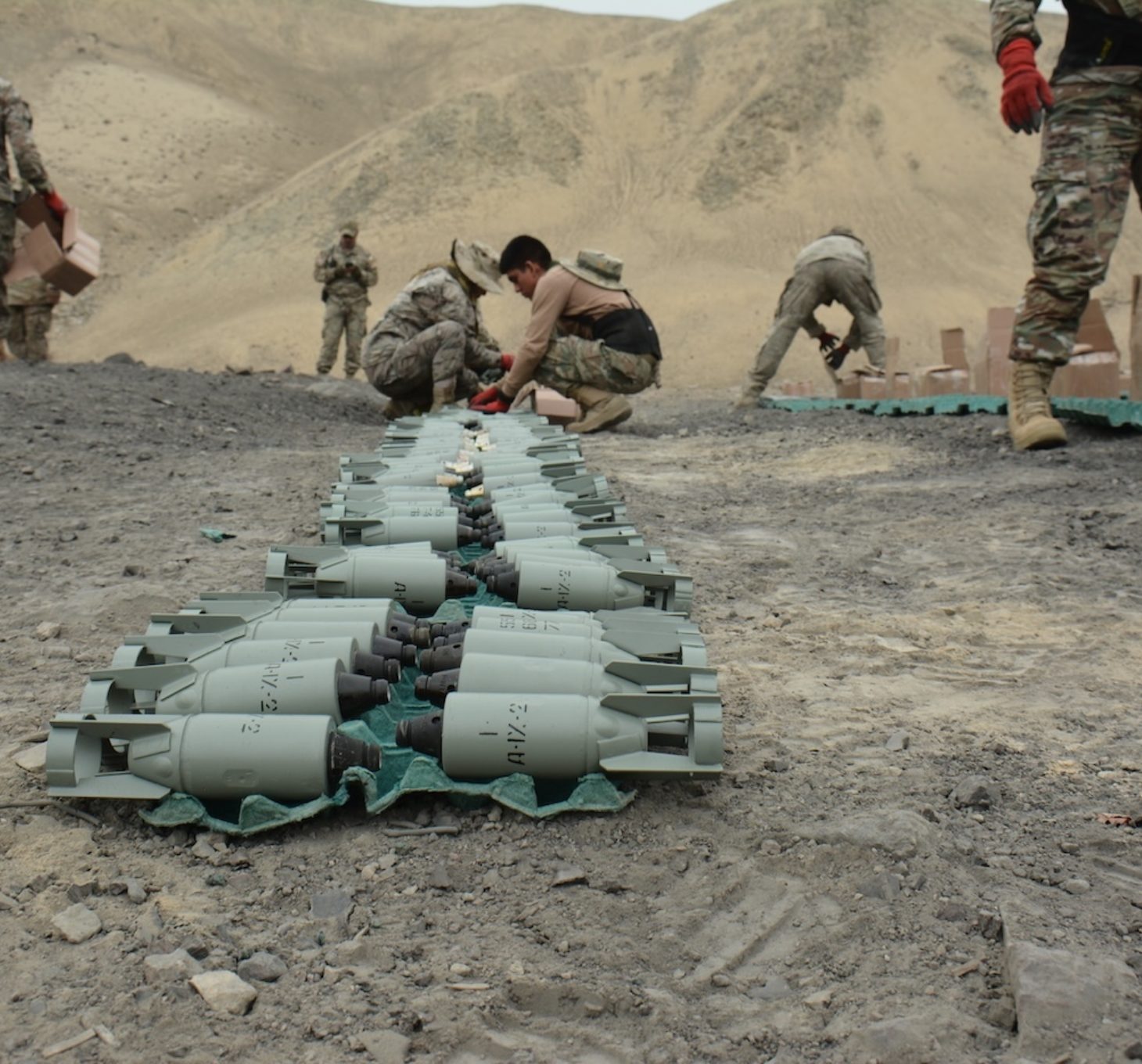
Launched Monday, 9 September, this is the 15th annual Cluster Munition Monitor report. It focuses on calendar year 2023, with information included up to August 2024 where possible.
https://www.the-monitor.org/reports/cluster-munition-monitor-2024
 LANDMINE MONITOR 2023
Launched Tuesday, 14 November, this is the 25th annual Landmine Monitor report. It focuses on calendar year 2022, with information included up to October 2023 where possible.
https://www.the-monitor.org/reports/landmine-monitor-2023
Chapters on developments in specific countries and other areas are available in online Country Profiles, found here.
| Download full report: | View press release: |

Landmine Monitor 2021
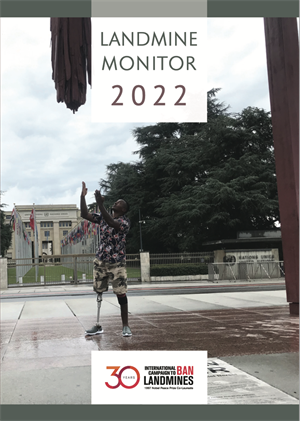
| The 23nd annual Landmine Monitor report provides a global overview of efforts to universalize and fully implement the 1997 Mine Ban Treaty, ensure clearance of mine contaminated areas, deliver risk education to affected communities, and assist victims of these weapons.More generally, the report assesses the international community’s response to the global landmine situation, focusing on calendar year 2020 with information included up to October 2021. It covers mine ban policy, use, production, trade, and stockpiling globally; contains information on developments and challenges in assessing and addressing the impact of mine contamination and casualties through clearance, risk education, and victim assistance; and documents global trends in support for mine action.Chapters on developments in specific countries and other areas are available in online Country Profiles, found here. | |
Cluster Munition Monitor 2021
| This is the 12th annual Cluster Munition Monitor report. http://www.the-monitor.org/en-gb/reports/2021/cluster-munition-monitor-2021.aspxCluster Munition Monitor 2021 covers cluster munition ban policy, use, production, transfers, and stockpiling globally, and also contains information on the impact of cluster munition contamination and casualties, as well as developments and challenges in addressing such impact through clearance, risk education and victim assistance. | 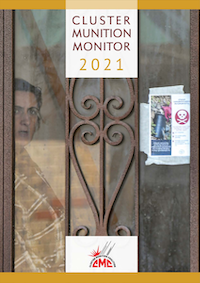 |
Landmine Monitor 2019
| Published: 21 November 2019This is the 21th annual Landmine Monitor Report. It is the sister publication to the Cluster Munition Monitor Report, first published in November 2010. Landmine Monitor 2019 provides a global overview of efforts over the past 20 years, and up to November 2019 where possible, to implement and universalize the Mine Ban Treaty. Chapters on developments in specific countries and other areas are available in online Country Profiles, found here.Landmine Monitor covers mine ban policy, use, production, trade, and stockpiling in every country in the world, and also includes information on contamination, clearance, casualties, victim assistance, and support for mine action. Including a 20-year review, the reporting period covered in this report is calendar year 2018, with information included up to November 2019 when possible. |  |
Cluster Munition Monitor 2019
| Published 29 August 2019This is the tenth annual Cluster Munition Monitor report. It is the sister publication to the Landmine Monitor report, which has been issued annually since 1999.Using the 2008 Convention on Cluster Munitions as its principal frame of reference, the report covers global trends in ban policy and practice, contamination and clearance, cluster munition casualties, and efforts to guarantee the rights and meet the needs of cluster munition victims. Profiles published online provide additional country-specific findings on these topics. Thematic maps are also published in the report and available online. |
The report focuses on calendar year 2018 with some information updated into August 2019 where possible.
 Cluster Munition Monitor 2018