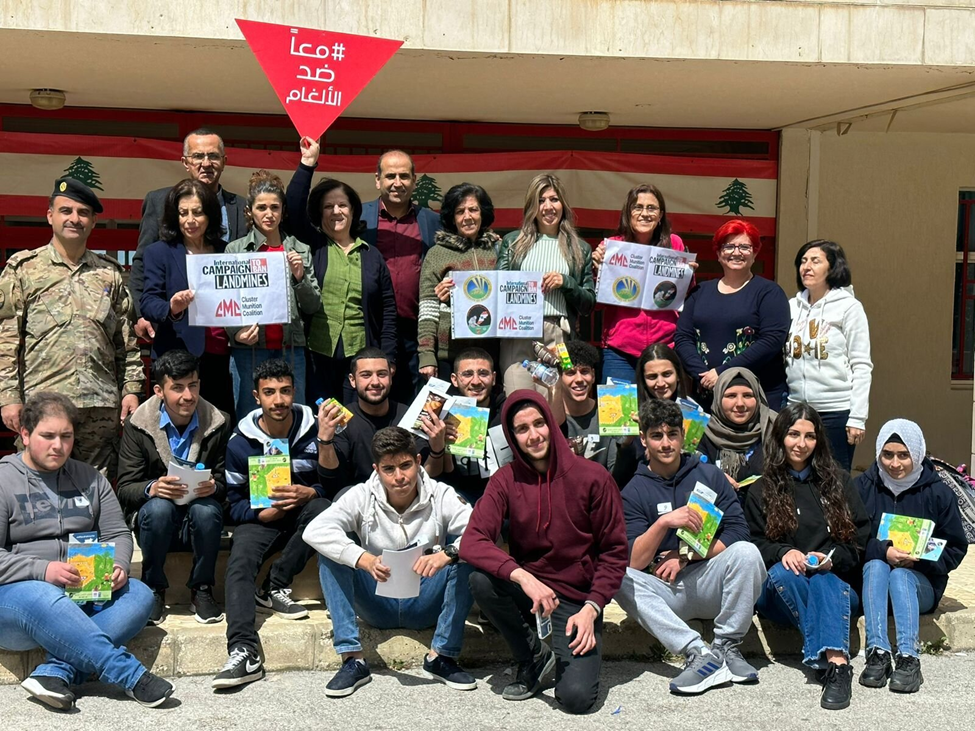
PHOTO: ICBL
Geneva, May 2026 – Lebanon deposited its instrument of accession to the 1997 Mine Ban Treaty with the United Nations Secretary-General on 1 May 2026, becoming the 162nd State Party to a treaty that comprehensively bans the use, production, stockpiling, and transfer of anti-personnel landmines. The treaty will enter into force for Lebanon on November 1st, 2026.
Lebanon’s accession comes at a fraught moment for the Mine Ban Treaty, as five European states have withdrawn recently and the United States has reversed decades of policy to authorize global landmine use back in December 2025. Against that backdrop, Lebanon’s decision to join the treaty carries particular weight: a country currently caught in a devastating war with Israel and one that for years kept landmines on the table as a security has chosen the path of humanitarian disarmament. A decision that will ultimately benefit the protection of civilians, who account for more than 90 percent of landmine casualties worldwide, according to the Landmine Monitor 2025 report.
“Even in the midst of war, Lebanon has made the right choice. Joining the Mine Ban Treaty is a commitment to protect Lebanese civilians who have paid the heaviest price for decades of conflict and contamination,” said Habbouba Aoun, Director, Landmine Resource Centre. “This accession shows that humanitarian principles must hold even during armed conflicts, and that the protection of civilians must always take precedence over the military logic of indiscriminate weapons.”
Lebanon is already a party to the Convention on Cluster Munitions and the Convention on Conventional Weapons, meaning this accession brings its formal legal commitments into alignment with long-standing practice and policy.
Despite its decades-long hesitation to accede the Mine Ban Treaty, Lebanon never entirely turned its back on the treaty’s humanitarian goals. It attended treaty meetings regularly, including the Fifth Review Conference in Siem Reap in November 2024 and the Twenty-Second Meeting of States Parties in Geneva in December 2025, and voted consistently in favor of annual UN General Assembly resolutions calling for the treaty’s universalization.
The decision is all the more significant given Lebanon’s own history with landmine contamination. The majority of contamination is in the south, along the Blue Line border with Israel, the legacy of successive conflicts. As recently as March 2025, a UN Interim Force in Lebanon (UNIFIL) soldier was injured in a landmine explosion in southwest Lebanon.
Lebanon has also confirmed that it has never produced or exported antipersonnel mines, and that its army retains only a minimal stockpile for training purposes.
“At a time when some countries want to bring back weapons that the world had collectively agreed to abandon, Lebanon’s accession is a powerful reminder that antipersonnel landmines have never been a solution,” said Tamar Gabelnick, Director of ICBL. “They kill and maim civilians for decades after conflicts end, with devastating humanitarian consequences that far outweigh any military utility. Lebanon has chosen protection over proliferation, and we welcome it wholeheartedly into the community of states committed to a mine-free world.”
We congratulate Lebanon and all campaigners who worked so diligently for this life-saving measure.